

Why Spreadsheets Still Dominate in Construction (and Why That’s a Problem)
For decades, spreadsheets have been the go-to tool for tracking construction budgets, schedules, and project updates. They’re familiar, flexible, and easy to set up. Many project managers, especially in public agencies, still rely on Excel or Google Sheets to track capital improvement programs (CIPs).
The problem?
Spreadsheets were never designed for the complexity of modern construction project management. They lack the ability to manage multi-year capital programs, enforce audit-ready compliance, and support collaboration across distributed project teams. What seems like a cost-saving solution often introduces inefficiencies, hidden risks, and expensive mistakes.
Industry research reinforces this: according to McKinsey, construction productivity has lagged behind other industries for decades, with poor information management being one of the top causes. Spreadsheets, while familiar, perpetuate inefficiency instead of solving it.
The Hidden Costs of Spreadsheet-Dependant Workflows
On the surface, spreadsheets look free. But the hidden costs quickly add up:
- Time Drain: Teams waste hours manually entering data, consolidating updates, and double-checking formulas. Every version passed around by email multiplies the risk of error.
- Compliance Risks: Public sector projects demand strict documentation and audit trails. Spreadsheets offer no built-in version history or permissions, leaving agencies exposed to failed audits, grant clawbacks, or even funding freezes.
- Lack of Visibility: Project leaders need portfolio-level dashboards. With spreadsheets, executives often rely on outdated data, receiving updates days or weeks after issues have already escalated.
These challenges mean that while spreadsheets seem inexpensive, they are among the most expensive tools in terms of opportunity cost, risk exposure, and lost efficiency.
How Spreadsheet Errors Drive Construction Rework
Construction rework is one of the industry’s biggest hidden costs. And spreadsheets are a direct contributor. When teams rely on outdated or conflicting versions of budgets, drawings, or RFIs:
- Field crews work from the wrong specifications.
- Subcontractors submit RFIs or pay apps based on incorrect data.
- Change orders slip through the cracks, leading to disputes and missed deadlines.
Without a centralized, controlled system of record, small spreadsheet errors cascade into large-scale rework, consuming valuable time and resources.
The Real Cost of Rework (Delays, Budget Overruns, Disputes)
According to the Construction Industry Institute (CII), rework accounts for up to 5% of total construction costs. For a $50 million capital project, that’s $2.5 million wasted, often on preventable mistakes.
Beyond the dollars:
- Delays compound: Missed milestones push back inspections, funding releases, and public commitments.
- Budgets spiral: Owners are forced to absorb unplanned costs or enter disputes with contractors.
- Relationships suffer: Trust between agencies, contractors, and the public erodes when projects appear mismanaged.
The hidden cost of rework isn’t just financial—it can damage public trust, jeopardizing future bond measures or funding initiatives.
How to Break The Cycle with Purpose-Built Construction Software
Moving beyond spreadsheets isn’t just about efficiency; it’s about preventing costly errors and enhancing visibility and organization across projects. A purpose-built Project Management Information System (PMIS) like CIPO Software addresses the root causes of spreadsheet-driven rework:
- Version Control: Always know which drawing, budget, or document is the current one. Audit trails eliminate confusion and ensure accountability.
- Real-Time Dashboards: Executives and project managers get live insights into budget status, schedule health, and compliance risks without waiting for manual reports.
- Role-Based Workflows: RFIs, pay apps, and Submittals move seamlessly through approval chains with permissions tailored to each stakeholder.
Compliance-Ready Reporting: Automated logs and documentation ensure public agencies are always audit-ready, meeting the demands of funders and regulators.
A Roadmap for Moving Beyond Spreadsheets
Transitioning away from spreadsheets doesn’t have to happen overnight. Here’s a practical roadmap public agencies and construction owners can follow:
- Audit Your Current Processes: Identify where spreadsheets are used and where errors or delays are most common.
- Define Key Workflows to Standardize: Start with high-impact workflows such as pay apps, RFIs, or Submittals.
- Pilot with a Single Project: Implement PMIS software on one capital project to test workflows and refine dashboards, even if run in parallel to existing approaches.
- Train and Onboard Stakeholders: Ensure contractors, consultants, and internal teams understand the new system and its benefits.
- Scale Portfolio-Wide: Implement standardized workflows across all projects to ensure consistency and compliance.
By taking a phased approach, teams can reduce resistance to change while gaining early wins that demonstrate improved visibility, control, and efficiency.
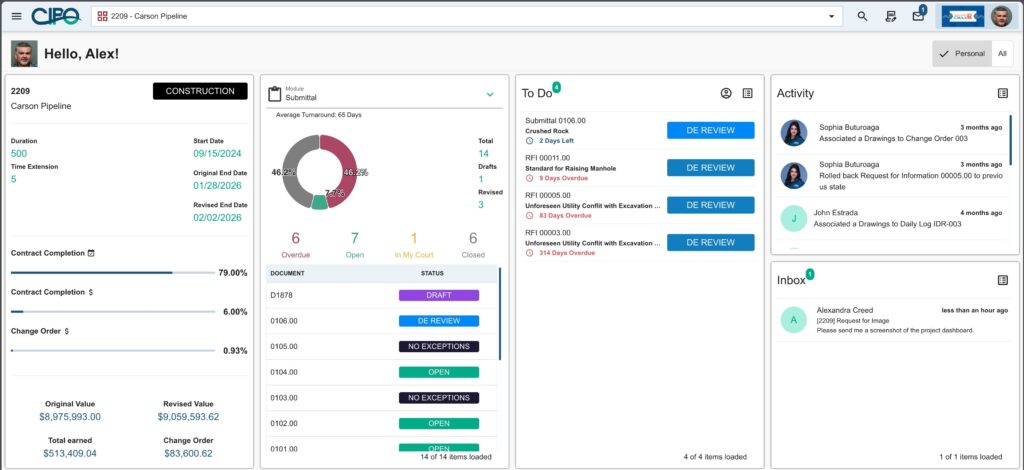
Real-World Results: Agencies Reducing Spreadsheet Dependance and Rework
Agencies across North America are already seeing the benefits of moving away from spreadsheets. For example, the Inland Empire Utilities Agency (IEUA) in California leveraged CIPO to manage a $450 million expansion program. With thousands of RFIs, submittals, and drawings in circulation, spreadsheets and shared drives simply couldn’t keep up. By adopting CIPO’s centralized platform, IEUA reduced rework, improved version accuracy, and maintained project accuracy.
Similarly, Eastern Municipal Water District (EMWD) adopted CIPO when legacy tools could no longer support its workflow. By standardizing dashboards and workflows across its capital improvement portfolio and developer projects, EMWD cut reporting time dramatically and strengthened compliance oversight.
The results are clear: when teams break free from spreadsheets, they gain control, cut costs, and deliver projects with confidence.