
Why Some Construction Owners Choose CIPO Instead of Procore
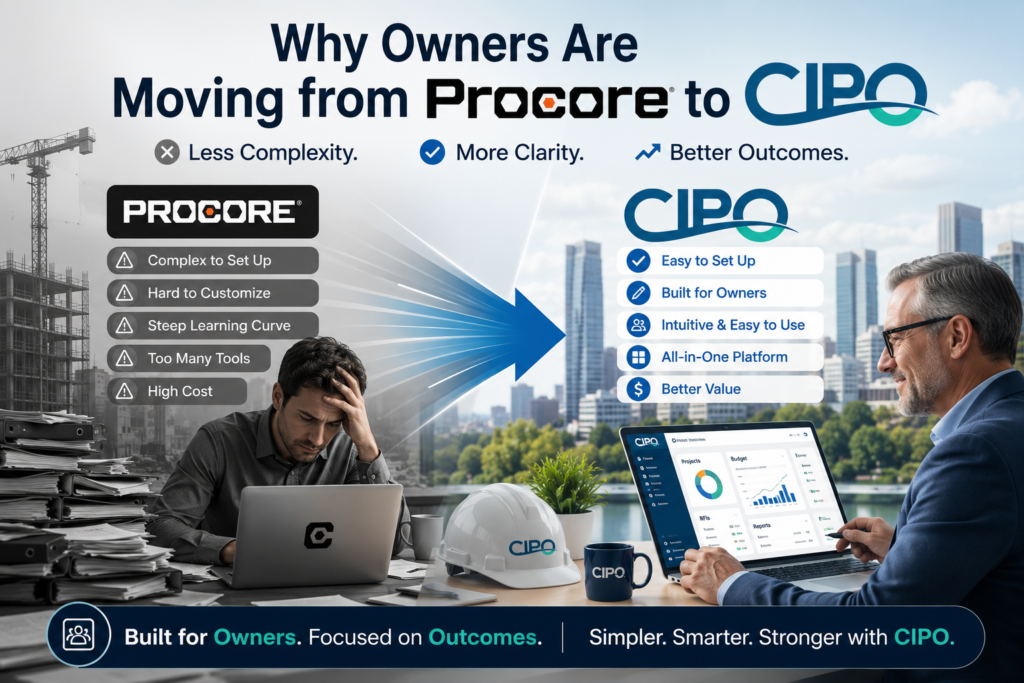
Construction project management software has helped modernize the way teams manage RFIs, submittals, documents, change orders, and field activities. Platforms like Procore have become widely known in the construction industry, especially among general contractors and construction teams.
But construction owners have different needs.
Public agencies, water districts, municipalities, educational institutions, and capital program owners are not just managing a single construction project. They are managing long-term infrastructure programs, internal approvals, funding requirements, compliance, consultants, contractors, inspectors, executives, and the official project record.
That is why several owner organizations have transitioned to CIPO after using Procore, including Calaveras County Water District, Rancho California Water District, and Las Virgenes Municipal Water District.
Their decision was not simply about replacing one software system with another. It was about adopting a platform built around the way owners actually manage capital projects.
The Challenge: Contractor-Centric Tools Do Not Always Fit Owner Needs
Procore is a strong platform for many contractors, but owner organizations often need a different operating model.
Owners need standardized governance across departments. They need visibility across multiple projects and programs. They need approval workflows that reflect internal policies. They need reporting that supports executives, boards, finance teams, project managers, inspectors, and consultants. Most importantly, they need control over the full project record.
When a platform is primarily designed around contractor-led project execution, owners may find themselves adapting their processes to the software rather than the software supporting the way they work.
Common challenges many owner organizations tell us include:
- Limited owner-side program visibility
- Difficulty standardizing workflows across multiple projects
- Added complexity around public agency approvals
- Heavy reliance on spreadsheets, email, or outside reporting
- Limited flexibility for owner-specific dashboards and analytics
- Licensing models that can restrict broad stakeholder adoption
- Challenges in maintaining a consistent owner-controlled project record
For capital program owners, managing construction activity is only part of the job. The bigger goal is to create structure, visibility, accountability, and confidence across the full lifecycle of each project.
Why Rancho Water, Las Virgenes and Calaveras County Water District Chose CIPO
Calaveras County Water District, Rancho California Water District, and Las Virgenes Municipal Water District represent the type of owner organization CIPO was built to serve.
These agencies manage complex capital programs involving multiple projects, consultants, contractors, and stakeholders. Success depends on having consistent processes, reliable documentation, streamlined workflows, and real-time visibility across every phase of project delivery.
By adopting CIPO, each organization implemented a platform purpose-built for owners—not contractors. CIPO provides a centralized environment for managing project documentation, approvals, correspondence, collaboration, reporting, and portfolio visibility, giving teams a single source of truth to deliver capital programs with greater efficiency, transparency, and control.
Customer Proof: Owners Moving to a Better-Fit Platform
Owner-Controlled Project Delivery
Each organization had its own priorities, business processes, and capital program requirements, but they shared a common objective: implementing a platform designed specifically for owner-led project delivery rather than contractor-centric project management.
Calaveras County Water District selected CIPO to modernize its capital project management while improving visibility, consistency, and control across project documentation and workflows. By standardizing processes within a single owner-focused platform, the District can better coordinate with consultants, contractors, and internal stakeholders while maintaining a complete, searchable record of every project throughout its lifecycle.
Rancho California Water District adopted CIPO to better support its owner-driven approach to capital program management. With CIPO, Rancho Water standardized project documentation, approvals, and collaboration across internal teams and external partners, while establishing a foundation for expansion into developer projects and internal service requests. Rather than managing these initiatives across multiple systems, Rancho Water now has a single platform that supports capital delivery, development coordination, and enterprise-wide business processes.
Las Virgenes Municipal Water District also adopted CIPO to strengthen its capital project delivery program. As a public water agency responsible for managing complex infrastructure investments, Las Virgenes benefits from structured owner workflows, secure collaboration, standardized documentation, and comprehensive reporting within a platform purpose-built for long-term program governance and record management.
Together, these organizations represent a growing trend among public agencies and infrastructure owners. They are moving beyond contractor-focused construction management software in favor of owner-first program management platforms that provide greater visibility, stronger governance, standardized processes, and a single source of truth across their entire capital program.
CIPO helps owners maintain control over their project records, workflows, and processes.
Instead of relying on contractor-driven structures, owners can define how RFIs, submittals, change orders, pay applications, inspections, daily reports, correspondence, and approvals are managed across their organization.
This allows agencies and institutions to create consistency across projects while still supporting the needs of consultants, contractors, inspectors, and internal departments.
For organizations like Rancho Water and Las Virgenes, this owner-first structure is critical. It ensures that the system supports the owner’s governance model rather than forcing the owner to work around someone else’s process.
Better Visibility Across Projects and Programs
Owners need more than project-level document tracking. They need to understand what is happening across their entire capital program.
CIPO provides visibility into projects, documents, budgets, milestones, approvals, risks, and activity across the organization. This gives project managers, executives, and leadership teams better insight into project health and program performance.
Instead of relying on disconnected updates or manually assembled reports, teams can access structured information directly from the system.
That level of visibility helps owners make faster, more informed decisions.
Standardized Workflows and Approvals
Public agencies and owner organizations often have multi-step approval processes involving project managers, engineers, inspectors, finance teams, executives, consultants, and contractors.
CIPO supports configurable workflows that route documents to the right people, track review status, maintain accountability, and preserve a clear audit trail.
This helps reduce manual follow-up, improve turnaround times, and create a more consistent review process across the organization.
For owners, this means fewer bottlenecks and better control over project decisions.
Stronger Collaboration Without Losing Governance
Capital projects require collaboration between many different stakeholders. Internal teams, construction managers, designers, inspectors, consultants, contractors, and executives all need access to the right information at the right time.
CIPO provides a secure, role-based environment where stakeholders can collaborate while the owner maintains control over permissions, workflows, records, and reporting.
This creates a better balance between collaboration and governance.
Everyone can participate in the project process, but the owner remains in control of the official record.
Reporting and Analytics Built Around Owner Priorities
One of the major benefits of moving to CIPO is access to structured project data.
CIPO helps owners move away from disconnected spreadsheets, email updates, and manually prepared reports. Project information is captured consistently across workflows, making it easier to generate dashboards, track performance, monitor risk, and support leadership reporting.
For owner organizations, this is especially important because reporting is not just about the construction team. It often supports executive leadership, boards, finance departments, auditors, and public accountability.
CIPO helps turn project documentation into program intelligence.
A Scalable Platform for Broader Adoption
Owner organizations often need more than a small group of licensed users. They need project managers, inspectors, executives, finance teams, consultants, and contractors working together.
CIPO is designed to support broad stakeholder participation across departments and project teams. This makes it easier for organizations to standardize adoption and create a single source of truth across the capital program.
For organizations like Rancho Water and Las Virgenes, scalability matters because capital delivery is not limited to one department or one project team. It requires alignment across the organization.
Purpose-Built for Construction Owners
CIPO was designed from day one specifically for owner organizations managing capital programs
That focus matters.
Rather than adapting a contractor-centric platform to fit owner needs, CIPO provides workflows, reporting, permissions, and program visibility designed around the owner’s role.
This is especially valuable for water districts, public agencies, municipalities, and education institutions that need structured documentation, auditability, transparency, and long-term project history.
The Benefits Customers Realize After Moving to CIPO
Organizations that migrate from Procore to CIPO often realize benefits such as:
- Better control of the official project record
- More consistent workflows across projects
- Improved visibility into capital programs
- Stronger collaboration between owners, consultants, and contractors
- More structured approvals and audit trails
- Reduced reliance on spreadsheets and manual reporting
- Better access to dashboards and analytics
- A platform that reflects owner-side priorities
- Greater ability to scale adoption across internal and external stakeholders
For Rancho Water and Las Virgenes Municipal Water District, the move to CIPO reflects a larger trend: owners are looking for systems built around their needs, not just contractor workflows.
Moving Beyond Contractor-Centric Project Management
Procore helped define a generation of construction project management software. But as owner organizations mature and capital programs become more complex, many are realizing they need a different kind of platform.
They need software that supports owner governance, program visibility, structured approvals, data ownership, and long-term capital planning.
That is where CIPO stands apart.
CIPO gives owners a modern, purpose-built platform to manage projects, programs, stakeholders, documentation, approvals, and reporting from one centralized system.
Built for Owners. Designed for Progress.
Rancho California Water District, Calaveras County Water District, and Las Virgenes Municipal Water District are examples of organizations moving toward a more owner-focused approach to capital project delivery.
Their transition to CIPO is part of a broader shift in the industry.
Owners want more control.
Owners want better visibility.
Owners want structured data.
Owners want a system that fits the way they actually work.
CIPO was built for that purpose.
For agencies, utilities, education institutions, and capital program owners looking to modernize their construction management process, CIPO provides a clear path forward: move beyond contractor-centric tools and adopt a platform designed for owner-side program management.
Procore is a registered trademark of its respective owner. Comparisons reflect CIPO’s assessment of product positioning and customer experiences and are intended for informational purposes.
