Construction PMIS Software for Public Agencies
CIPO is a construction PMIS built for owners of public infrastructure. It brings projects, budgets, documents and teams into one owner-controlled system of record, from planning through closeout. Water agencies, cities and other public agencies use it to manage infrastructure projects, municipal facilities and capital improvement programs.
What is a construction PMIS?
A construction PMIS (project management information system) is a centralized software platform that supports a project from planning to closeout. It brings documents, schedules, budgets, communication, reporting and workflows into one place. For the full explainer, read What Is a PMIS in Construction?
What a PMIS manages
CIPO connects the records owners rely on, so each one links to the decisions, costs and approvals behind it.
- ✓Documents and drawings: version control, searchable records, configurable approvals and an auditable history. See document management.
- ✓RFIs, submittals and change management: routed to the right people, with the full discussion kept in the project record.
- ✓Pay applications: each one tied to the approved Schedule of Values or bid items, change orders and project costs, with owner-defined approvals and a full audit trail. See pay application software.
- ✓Field activity: daily reports, inspections and updates from phones and tablets with CIPO Mobile, which supports iOS and Android.
- ✓Project controls: action and decision logs, risk management, permit tracking and design-phase coordination, added as your program needs them.
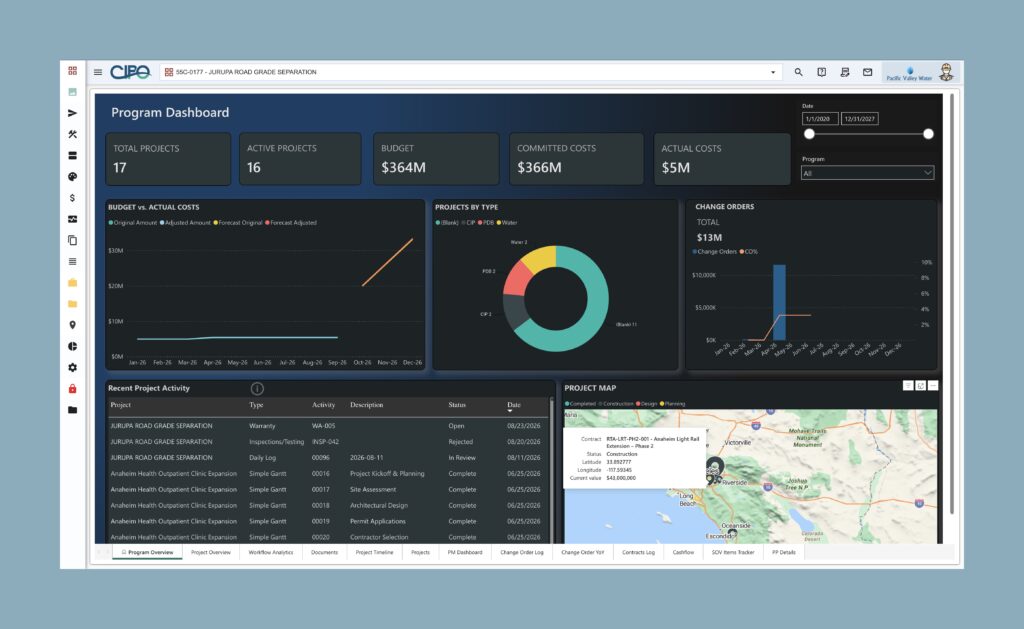
- ✓Reporting: dashboards and KPIs for executives, program teams, boards and stakeholders. See capital program analytics and reporting.
Together, this works as capital program management software rather than a set of separate tools. Because these records share one connected system, owners see more context than separate point solutions can give them.

Construction PMIS for owners, not contractors
Many construction platforms began around contractor project execution. CIPO starts from the owner’s side: governance, visibility and the permanent program record. Owners define the workflows, permissions and approvals, so your agency isn’t asked to adopt contractor-defined processes.
That doesn’t shut anyone out. Consultants, contractors, designers and inspectors get role-based access to the projects, records and actions they need, while the owner keeps control. CIPO’s owner-governed workflows also support general contractors, developers and trade partners. Learn more about construction management software for public agencies.
How CIPO fits
Public programs span departments, funding sources, consultants and contractors. CIPO gives owners one governed way to run all of them: standardize how projects move and approvals happen, connect documents, costs, schedules and field data, and give teams and executives portfolio-wide visibility.
It adapts to your process
Authorized administrators can configure forms, fields, workflows, permissions, notifications, dashboards and reports without code. Start with content packs for Construction, Design and Project Management, then adjust them to your requirements.
It works with your existing systems
CIPO integrates with Oracle Primavera P6 and Microsoft Project for scheduling. It offers an open REST API and connects to 300+ cloud systems through Microsoft iPaaS, including DocuSign and ArcGIS. For pay applications, it can connect to financial systems such as Workday, Oracle and SAP that support REST APIs. It doesn’t have to replace your ERP, scheduling, GIS or document systems.
It protects your data
CIPO runs on Microsoft Azure with role-based permissions and audit history. Each customer’s data is kept in a separate database.
FAQs
What are construction PMIS?
Construction PMIS are software platforms that centralize a project’s documents, costs, schedules, communication and workflows. Public agencies use them to keep capital projects consistent and visible from planning through closeout.
How does PMIS software improve public construction?
PMIS software replaces scattered spreadsheets, email and shared drives with one shared record. Dashboards show what is on track and what needs attention. Standardized processes cover everything from RFI reviews to contractor payments. Every approval, comment and change is logged, so records are ready when an auditor or funding agency asks.
What is a PMIS in construction?
It is a centralized platform that manages a construction project’s documents, budgets, schedules and workflows from planning to closeout. Our guide, What Is a PMIS in Construction?, covers it in full.
How is owner software different from construction management software built for contractors?
Many contractor-focused tools were built around crew scheduling and field execution. Owner software is built around governing an entire capital program: workflows, permissions, financial processes, documents and reporting that stay consistent across every project. With CIPO, the owner controls those rules, and contractors and consultants work inside the access the owner assigns.
Book a demo With CIPO
See how CIPO fits your agency’s workflows and gives your team clearer visibility, from the field to the executive dashboard.
EMWD has the potential to significantly elevate our digital operations by leveraging a dependable, user-friendly platform that provides flexibility and paves the way for future technological innovations.
Scott Lopian
Construction Administrator Manager